
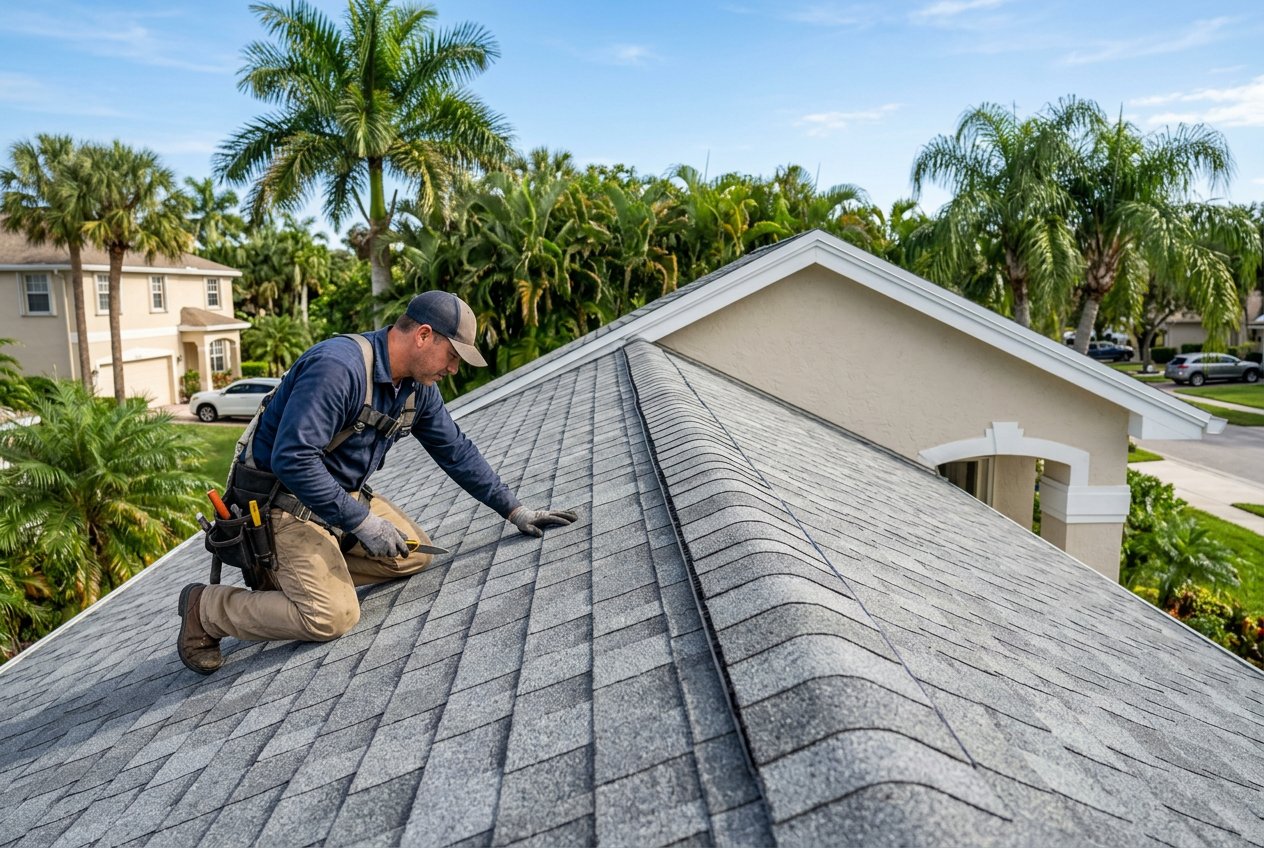
Most roof failures announce themselves months before water shows up on a ceiling. The trouble is that the early signs are easy to miss from the ground, and easy to explain away when you do notice them.
Here is what is worth looking for, and what each one usually means.
1. Granules collecting at the downspout
Asphalt shingles are surfaced with mineral granules that protect the mat underneath from ultraviolet light. Some loss is normal, especially on a new roof. A steady accumulation in the gutters or at the base of a downspout is not. It means the surface is wearing through, and once the mat is exposed it degrades quickly in South Florida sun.
2. Shingles that look flat or shiny in patches
Where granules have gone, the remaining surface reflects light differently. Stand back from the house and look across the plane of the roof rather than straight at it. Patches that look darker, flatter or shinier than their neighbours are usually areas that have lost their surface.
3. Lifted edges after a wind event
Wind uplift can break the adhesive seal between shingle courses without removing a single shingle. The roof looks intact and is no longer watertight in a driving rain. This is the most commonly missed form of storm damage, and it is the reason an inspection after a named storm is worth doing even when nothing is visibly missing.
4. Staining around penetrations
Vents, pipe boots and chimneys are where most leaks actually start. Rubber boots in particular perish in this climate and crack around the pipe. Dark staining on the roof surface downhill of a penetration is a strong hint that water has been running where it should not.
5. Anything sagging
A dip or a wave in the roof plane is a structural symptom, not a surface one. It usually means the decking has been wet for a long time. This is the one sign on this list that should not wait.
What to do about it
None of these five tells you, on its own, whether you need a repair or a replacement. That depends on how widespread the problem is and what condition the decking underneath is in, and neither of those can be judged from the driveway.
If you have spotted any of them, get the roof looked at properly. An inspection gives you the facts in writing, and knowing where the roof stands lets you plan the spend instead of reacting to it.
An inspection costs nothing and you get the findings in writing either way.
Request a Roof Inspection